
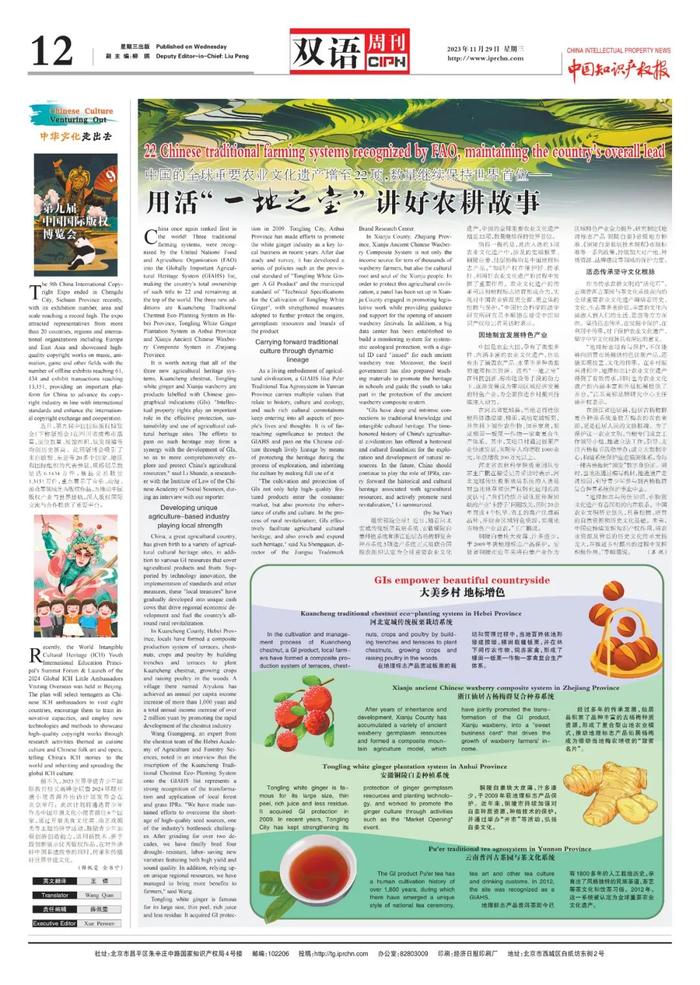
China once again ranked first in the world! Three traditional farming systems, were recognized by the United Nations' Food and Agriculture Organization (FAO) into the Globally Important Agricultural Heritage System (GIAHS) list, making the country's total ownership of such title to 22 and remaining at the top of the world. The three new additions are Kuancheng Traditional Chestnut Eco-Planting System in Hebei Province, Tongling White Ginger Plantation System in Anhui Province and Xianju Ancient Chinese Waxberry Composite System in Zhejiang Province.
It is worth noting that all of the three new agricultural heritage systems, Kuancheng chestnut, Tongling white ginger and Xianju waxberry are products labelled with Chinese geographical indications (GIs). "Intellectual property rights play an important role in the effective protection, sustainability and use of agricultural cultural heritage sites. The efforts to pass on such heritage may form a synergy with the development of GIs, so as to more comprehensively explore and protect China's agricultural resources," said Li Shunde, a researcher with the Institute of Law of the Chinese Academy of Social Sciences, during an interview with our reporter.
Developing unique agriculture-based industry playing local strength
China, a great agricultural country, has given birth to a variety of agricultural cultural heritage sites, in addition to various GI resources that cover agricultural products and fruits. Supported by technology innovation, the implementation of standards and other measures, these "local treasures" have gradually developed into unique cash cows that drive regional economic development and fuel the country's allround rural revitalization.
In Kuancheng County, Hebei Province, locals have formed a composite production system of terraces, chestnuts, crops and poultry by building trenches and terraces to plant Kuancheng chestnut, growing crops and raising poultry in the woods. A village there named Aiyukou has achieved an annual per capita income increase of more than 1,000 yuan and a total annual income increase of over 2 million yuan by promoting the rapid development of the chestnut industry.
Wang Guangpeng, an expert from the chestnut team of the Hebei Academy of Agriculture and Forestry Sciences, noted in an interview that the inscription of the Kuancheng Traditional Chestnut Eco-Planting System onto the GIAHS list represents a strong recognition of the transformation and application of local forest and grass IPRs. "We have made sustained efforts to overcome the shortage of high-quality seed sources, one of the industry's bottleneck challenges. After grinding for over two decades, we have finally bred four drought-resistant, labor-saving new varieties featuring both high yield and sound quality. In addition, relying upon unique regional resources, we have managed to bring more benefits to farmers," said Wang.
Tongling white ginger is famous for its large size, thin peel, rich juice and less residue. It acquired GI protection in 2009. Tongling City, Anhui Province has made efforts to promote the white ginger industry as a key local business in recent years. After due study and survey, it has developed a series of policies such as the provincial standard of "Tongling White Ginger: A GI Product" and the municipal standard of "Technical Specifications for the Cultivation of Tongling White Ginger", with strengthened measures adopted to further protect the origins, germplasm resources and brands of the product.
Carrying forward traditional culture through dynamic lineage
As a living embodiment of agricultural civilization, a GIAHS like Pu'er Traditional Tea Agrosystem in Yunnan Province carries multiple values that relate to history, culture and ecology, and such rich cultural connotations keep entering into all aspects of people's lives and thoughts. It is of farreaching significance to protect the GIAHS and pass on the Chinese culture through lively lineage by means of protecting the heritage during the process of exploration, and inheriting the culture by making full use of it.
"The cultivation and protection of GIs not only help high-quality featured products enter the consumer market, but also promote the inheritance of crafts and culture. In the process of rural revitalization, GIs effectively facilitate agricultural cultural heritage, and also enrich and expand such heritage," said Xu Shengquan, director of the Jiangsu Trademark Brand Research Center.
In Xianju County, Zhejiang Province, Xianju Ancient Chinese Waxberry Composite System is not only the income source for tens of thousands of waxberry farmers, but also the cultural root and soul of the Xianju people. In order to protect this agricultural civilization, a panel has been set up in Xianju County engaged in promoting legislative work while providing guidance and support for the opening of ancient waxberry festivals. In addition, a big data center has been established to build a monitoring system for systematic ecological protection, with a digital ID card "issued" for each ancient waxberry tree. Moreover, the local government has also prepared teaching materials to promote the heritage in schools and guide the youth to take part in the protection of the ancient waxberry composite system.
"GIs have deep and intrinsic connections to traditional knowledge and intangible cultural heritage. The timehonored history of China's agricultural civilization has offered a historical and cultural foundation for the exploration and development of natural resources. In the future, China should continue to play the role of IPRs, carry forward the historical and cultural heritage associated with agricultural resources, and actively promote rural revitalization," Li summarized.(by Su Yue)
继续领跑全球!近日,随着河北宽城传统板栗栽培系统、安徽铜陵白姜种植系统和浙江仙居古杨梅群复合种养系统3项遗产系统正式被联合国粮农组织认定为全球重要农业文化遗产,中国的全球重要农业文化遗产增至22项,数量继续保持世界首位。
值得一提的是,此次入选的3项农业文化遗产中,涉及的宽城板栗、铜陵白姜、仙居杨梅均是中国地理标志产品。“知识产权在保护好、传承好、利用好农业文化遗产的过程中发挥了重要作用。农业文化遗产的传承可以和地理标志培育形成合力,实现对中国农业资源更全面、更立体的挖掘与保护。”中国社会科学院法学研究所研究员李顺德在接受中国知识产权报记者采访时表示。
因地制宜发展特色产业
中国是农业大国,孕育了类型多样、内涵丰富的农业文化遗产,也培育出了涵盖农产品、水果等多种类型的地理标志资源。这些“一地之宝”在科技创新、标准建设等手段的助力下,逐渐发展成为带动区域经济发展的特色产业,为全面推进乡村振兴持续注入动力。
在河北省宽城县,当地老百姓依地形修建撩壕、梯田,栽植宽城板栗,并在林下间作农作物、饲养家禽,形成梯田—板栗—作物—家禽复合生产体系。其中,艾峪口村通过板栗产业快速发展,实现年人均增收1000余元,年总增收200万元以上。
河北省农林科学院板栗团队专家王广鹏在接受记者采访时表示,河北宽城传统板栗栽培系统的入选是对当地林草知识产权转化运用的高度认可。“我们持续开展优质种源短缺的产业‘卡脖子’问题攻关,历时20余年育成4个抗旱、省工的高产优质新品种,并结合区域特色资源,实现地方特色产业惠农。”王广鹏说。
铜陵白姜块大皮薄、汁多渣少,于2009年获地理标志产品保护。安徽省铜陵市近年来将白姜产业作为区域特色产业全力提升,研究制定《地理标志产品铜陵白姜》省级地方标准、《铜陵白姜栽培技术规程》市级标准等一系列政策,持续加大对产地、种质资源、品牌建设等领域的保护力度。
活态传承坚守文化根脉
作为传承农耕文明的“活化石”,云南普洱古茶园与茶文化系统在内的全球重要农业文化遗产凝结着历史、文化、生态等多重价值,丰富的文化内涵渗入到人们的生活、思想等方方面面。坚持活态传承,在发掘中保护、在利用中传承,对于保护农业文化遗产、坚守中华文化根脉具有深远的意义。
“地理标志培育与保护,不仅能够向消费市场提供特色优质产品,还能实现技艺、文化的传承。在乡村振兴进程中,地理标志让农业文化遗产得到了有效传承,同时也为农业文化遗产的内涵丰富和外延拓展提供了养分。”江苏商标品牌研究中心主任徐升权表示。
在浙江省仙居县,仙居古杨梅群复合种养系统是数万梅农的衣食来源,更是仙居人民的文脉根魂。为了保护这一农业文明,当地专门成立工作领导小组、推进立法工作,引导、支持古杨梅节活动举办;成立大数据中心,构建系统保护生态监测体系,为每一棵古杨梅树“颁发”数字身份证。同时,当地还通过编写教材,推进遗产走进校园,引导青少年参与到古杨梅群复合种养系统保护事业中去。
“地理标志与传统知识、非物质文化遗产有着深刻的内在联系。中国农业文明历史悠久,具备挖掘、培育的自然资源和历史文化基础。未来,中国应持续发挥知识产权作用,将农业资源及背后的历史文化传承发扬光大,在推进乡村振兴的过程中发挥积极作用。”李顺德说。(苏悦)
(文章来源:中国知识产权报 原标题:中国的全球重要农业文化遗产增至22项,数量继续保持世界首位——用活“一地之宝”讲好农耕故事)
(编辑:晏如 责任编辑:吕可珂 审校:崔静思)